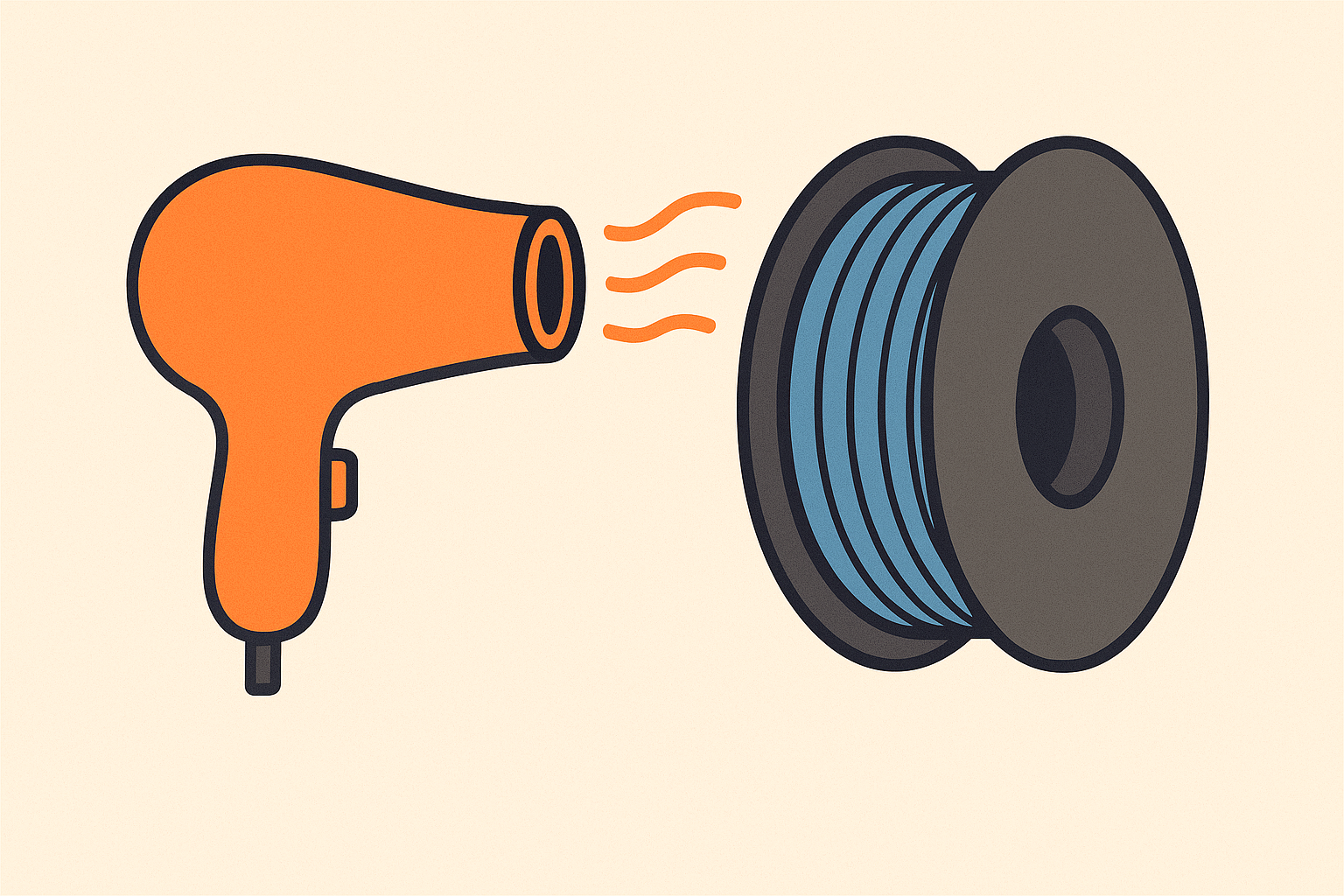
Drying filament is one of those beginner topics that sounds like “extra effort”… until you see a print covered in strings, bubbles, or a weird rough texture. Both PLA and PETG can absorb moisture from the air over time. When that moisture hits a hot nozzle, it flashes into steam and can mess with extrusion, surface finish, and sometimes strength. This article breaks down what actually happens, what real “wet vs. dry” tests show, and how to dry filament safely without overcomplicating your setup.
Why Filament Absorbs Water
Most common 3D printing plastics are hygroscopic, meaning they slowly pull water vapor out of the air. You usually don’t see it on the spool, but inside the filament that moisture matters a lot once it gets heated.
When wet filament is pushed through a nozzle (typically 200–250°C), the absorbed water rapidly turns into steam. That steam can create:
- Micro-bubbles in the extrusion
- Pitting (tiny holes) and rough surface texture
- Unstable flow (inconsistent extrusion)
- Weaker layer bonding in some cases
In simple terms: moisture turns your smooth plastic flow into a bubbly, foamy mess.
How Wet Filament Shows Up in Real Prints
Wet filament doesn’t always “fail” dramatically. Often it just makes prints uglier and less predictable. Common symptoms include:
- Popping / crackling / hissing sounds while printing (steam escaping)
- Extra stringing and wispy “hair” between parts
- Rough or matte finish instead of smooth/glossy
- Tiny bumps or pimples on outer walls
- Weaker details (corners and text look softer)
- Brittle filament that snaps easily off the spool (sometimes)
You’ll usually notice these problems more clearly on long retractions, small towers, bridges, and thin walls.
Wet vs. Dry Test Results: What Others Found
A lot of creators have done “before/after drying” tests. The consistent pattern is:
- PLA: often prints “okay” even when slightly wet, but may show more stringing and slightly worse surface finish
- PETG: shows stronger negative effects when wet—stringing, rough surfaces, and sometimes weaker layer adhesion
PLA: Wet vs. Dry
In many real-world tests, PLA differences are subtle unless the filament is very wet or has been stored badly. Common “wet PLA” differences reported:
- Slight increase in stringing
- More surface “fuzz” and tiny blobs
- More inconsistent extrusion on fine detail
However, PLA can still absorb enough moisture over time to cause visible quality loss, especially in humid rooms or if left out for weeks. Drying PLA often improves:
- Cleanliness of retractions
- Surface finish
- Reliability on long prints
PETG: Wet vs. Dry
PETG tends to show a much bigger “wet vs. dry” difference. In multiple tests, wet PETG commonly produced:
- Heavy stringing (sometimes “spider web” level)
- Matte, rough, or “satin” surface instead of smooth and glossy
- Small voids / bubbles visible in walls
- Occasionally poorer layer adhesion (more brittle prints)
If you ever printed PETG and thought “why is this so stringy?”, moisture is one of the first things to check.
Quick Checklist: Is My Filament Wet?
If you see 2–3 of these at the same time, drying is worth trying:
- Popping/hissing during extrusion
- New sudden stringing on settings that used to work
- Rough outer walls / tiny pits
- Inconsistent extrusion (looks foamy)
- Clear filament turning hazy or milky
How to Dry PLA and PETG (Beginner Friendly)
You don’t need expensive equipment. You just need controlled low heat for several hours. Below are the most common beginner-safe options.
Option 1: Filament Dryer (Easiest + Most Consistent)
A dedicated filament dryer is the simplest approach: set temperature, wait, print. Many dryers can also dry while feeding filament directly to the printer, which helps keep PETG stable during long prints.
Typical drying ranges:
- PLA: ~45–55°C for 4–6 hours
- PETG: ~55–65°C for 4–6 hours
If the spool is very wet (left out for weeks or in a damp shed/garage), increase time rather than temperature.
Option 2: Food Dehydrator (Great Value)
A food dehydrator is popular because it provides steady low heat and airflow. It’s often safer and more even than an oven.
Typical drying ranges:
- PLA: ~45–55°C for 4–6 hours
- PETG: ~55–65°C for 4–8 hours
Option 3: Oven (Works, But Be Careful)
An oven can work, but it’s the riskiest method because many ovens overshoot the target temperature. If you do it:
- Use an oven thermometer if possible
- Use the lowest stable temperature your oven can hold
- Don’t walk away for hours without checking
- Don’t let the spool touch heating elements
If your oven can’t reliably stay below ~65°C, skip this method. Overheating can soften filament and deform the spool.
Option 4: Airtight Storage + Desiccant (Prevention)
Silica gel and sealed storage won’t quickly rescue a very wet spool, but it helps prevent the problem from returning. Best practices:
- Store filament in airtight boxes or vacuum bags
- Add silica gel packs (replace or recharge when saturated)
- Keep spools sealed when not printing
So… Is Drying Really Necessary?
For PLA
Sometimes. PLA is more forgiving. If your PLA prints cleanly and you don’t hear popping or see bubbles/stringing, you can often ignore drying. But if PLA has been left out for a long time (especially in humid air), drying can noticeably improve consistency and finish.
For PETG
Usually yes. PETG is more moisture-sensitive in real printing. If you want clean walls, minimal strings, and reliable results, drying PETG is often the difference between “annoying prints” and “easy mode.”
Beginner Recommendation (Simple Routine)
- PLA: store sealed with desiccant; dry only when symptoms appear
- PETG: store sealed and dry more regularly (especially after being left out)
- If a spool has been open for weeks in a humid room: dry it before a long print
If you’re troubleshooting print quality, drying is one of the cheapest “first fixes” you can try before changing a dozen slicer settings.