Hobbyists and DIY roboticists often wonder if their FDM 3D printers can produce parts sturdy enough to stand in for metal. In many cases, 3D printed plastic parts can replace metal – but the success depends on material choice, design, and the application’s demands. This article explores how common filaments like PLA, ABS, and Nylon compare to metals in strength, stiffness, and durability, and when you can confidently substitute plastic for metal in your projects. We’ll highlight real-world examples where makers used printed parts instead of metal, and discuss technical caveats like layer adhesion, creep, and heat resistance.
The Appeal of Plastic over Metal
For DIY makers, 3D printing offers several advantages over traditional metal parts. You can create complex shapes with ease, save weight, and iterate designs quickly without machining. Polymers also have a high strength-to-weight ratio – advanced filaments like carbon-fiber nylon approach aluminum’s performance in moderate-load cases. Weight savings are significant: a study replacing a metal robot arm gripper with ABS plastic found the printed version was about 30% lighter than the aluminum original. This lighter weight can improve efficiency and payload capacity in robotics by reducing the load on motors. Moreover, printing spare parts on-demand enables “zero inventory” maintenance; you can fabricate custom brackets or gears as needed instead of waiting on metal fabrication.
That said, plastics are not as universally strong as metals. One research paper bluntly notes that thermoplastics cannot generally match the strength of metals – in tests, even the best 100%-infill ABS and Nylon parts had lower specific strength than aluminum. So, the question becomes: when is plastic “strong enough” for the job? The answer lies in choosing the right material and understanding its properties.
Material Properties: PLA vs. ABS vs. Nylon
3D printing filaments vary widely in mechanical properties. Here we focus on three popular materials (PLA, ABS, Nylon) and how each stacks up against metal in a practical sense.
PLA – Strong and Stiff, But Brittle
Polylactic Acid (PLA) is the go-to filament for many makers because it’s easy to print and quite strong in static conditions. A well-printed PLA part has high stiffness and good tensile strength – on the order of 50–60 MPa tensile strength, comparable to some aluminum alloys in strength-to-weight. In fact, PLA is one of the stiffest common 3D plastics (Young’s modulus ~2300 MPa) outstripping ABS and PETG, which is why projects like the Mostly Printed CNC use PLA for rigid structural parts. In room-temperature, static applications, a well-designed PLA bracket can perform surprisingly well. Some hobbyists have even raced 3D printed RC cars on PLA parts with success, demonstrating that if loads are within limits, PLA won’t shatter immediately.
However, PLA’s Achilles’ heel is its brittleness and low heat resistance. PLA parts tend to snap rather than bend under impact or excessive stress. The material softens around ~50–55 °C, so elevated temperatures or sunlight can deform PLA. (For example, a PLA widget left inside a hot car may warp or creep out of shape.) PLA is also prone to creep – under long-term loads it can slowly deform. These weaknesses mean PLA is not ideal for parts exposed to vibration, shock, or high heat. Use PLA for light-duty brackets, frames, or gears in cool environments, where its rigidity and strength shine, but avoid it for load-bearing parts in hot or impact-prone settings.
ABS – Tough, Impact-Resistant, and Heat Tolerant
Acrylonitrile Butadiene Styrene (ABS) is a classic engineering plastic used in many consumer products (think LEGO bricks or appliance housings). In 3D printing, ABS offers greater toughness and heat resistance than PLA at the cost of a bit less stiffness. Its tensile strength (~34 MPa) is lower than PLA’s on paper, but ABS parts can absorb shocks and flex slightly instead of shattering. Notably, ABS remains solid until around 95–100 °C, making it suitable for parts near engines or motors where PLA would soften. ABS is a good choice for robotics enclosures, car interior gadgets, or mounts near warm machinery, where you need moderate strength plus impact resistance.
The trade-off is that ABS is harder to print. It warps as it cools and releases fumes, so a heated bed and even an enclosure are recommended to get strong, accurate parts. Many hobby 3D printers struggle to maintain the ~240 °C nozzle temperature and stable environment ABS printing demands. But if you have the setup dialed in, ABS parts can be quite robust. In one case study of a robot arm gripper, 100% infill ABS parts were the most promising plastic replacement for metal, showing the highest strength-to-weight ratio among tested filaments. ABS printed at full density behaves more brittle than nylon (it will crack rather than bend), but it bonded between layers slightly better, possibly due to its material viscosity. In practice, ABS is a solid middle-ground for functional parts: it doesn’t match metal’s strength, but it handles many abuse scenarios (heat, drops, vibration) better than PLA.
Nylon – Durable and Wear-Resistant (Needs a Capable Printer)
Nylon is a tough, semi-flexible polymer that offers excellent impact and abrasion resistance. It’s the go-to material for many moving parts: gears, bushings, hinges, and other components that benefit from its low friction and fatigue resistance. In terms of strength, certain nylon formulations can rival or exceed ABS/PLA – e.g. Nylon 12 with carbon fiber can reach ~75 MPa tensile strength. More typically, printed nylon parts have moderate strength but high toughness: they tend to bend or yield before breaking, which is great for avoiding sudden failures. For example, a nylon 3D printed gear might deform under overload rather than shatter, potentially saving the mechanism. Nylon’s wear resistance also means it can sometimes replace metal in low-load bearings or slides without lubrication, where PLA would abrade quickly.
The challenge with nylon is printability – nylon requires an advanced printer and careful handling. Most nylon filaments need an extruder temperature around 250 °C (often only achievable with an all-metal hotend) and a heated bed ~70+ °C. Nylon is notorious for warping, so an enclosed build chamber is recommended to keep the ambient temperature high. It’s also hygroscopic: the filament must be kept dry; otherwise moisture causes weak, bubbly prints. In short, you typically need a well-tuned, capable printer to get strong nylon parts. Assuming you meet those requirements, nylon can yield very durable pieces. Many DIY robot builders use nylon (or nylon blends) for gears, motor mounts, and drive couplings that would traditionally be metal, taking advantage of its resilience. Just design for its properties – nylon is less stiff than PLA, so parts may need to be thicker to avoid flexing. When printed solid and dry, nylon parts can approach “functional prototype” performance similar to metal in moderate load cases, while being much lighter and corrosion-proof.
Note: There are many nylon blends (with carbon or glass fiber, etc.) that further improve stiffness and strength. These high-performance filaments blur the line with metal replacement, but they are pricier and still demand specialized printers. For most hobbyists, plain nylon or ABS are the upper end, unless you invest in those materials.
Real-World Examples of 3D Prints Replacing Metal
3D Printed CNC Machine Parts – A great example of plastics substituting metal is the “Mostly Printed CNC” (MPCNC) project. This DIY CNC router uses FDM printed parts (primarily PLA) for its structural brackets, carriages, and motor mounts, combined with metal tubing for rails. The design has been proven by countless makers to be rigid enough for woodworking and light aluminum milling. Why PLA? Its high stiffness helps keep the machine frame rigid. One MPCNC user noted “PLA is the stiffest commonly used filament,” with a Young’s Modulus around 2300 MPa, so it holds frame geometry better than more flexible plastics. The PLA parts successfully replace what would normally be aluminum or steel plates in a commercial CNC. Of course, the machine won’t rival a full-steel mill’s precision or load capacity, but for hobby purposes the printed parts work remarkably well. The key was designing the parts with thick walls, ribbing, and proper orientation for strength. Many builders report their PLA frames handling the cutting forces as long as the feed rates are tuned appropriately. This case shows that metal is not always necessary – with thoughtful engineering, plastic can do the job and save cost.
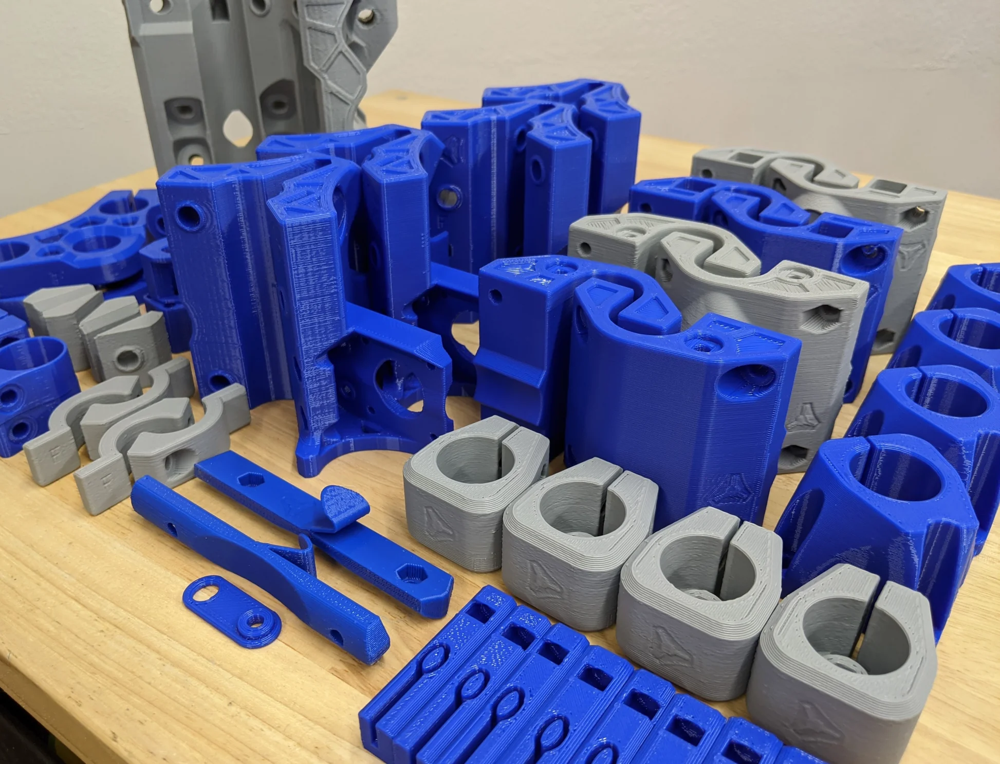
Printed PLA parts from the Mostly Printed CNC (MPCNC) – these components replace what would typically be metal brackets in a CNC machine. PLA’s high stiffness helps the CNC maintain rigidity. However, care is needed to avoid heat buildup that could soften the plastic.
Robotic Arm Gripper – In a research study, engineers replaced a factory metal end-of-arm tool (a gripper bracket on a Fanuc robot) with versions made from ABS and nylon via FDM printing. The results were promising: the 3D printed ABS part at 100% infill achieved the best strength-to-weight ratio among the tested plastics. While the printed parts were not as absolutely strong as aluminum, they were strong enough for the task and significantly lighter – the metal gripper weighed 226.5 g, whereas the ABS and Nylon ones were only ~155 g, about a one-third weight reduction. This weight savings meant the robot could operate with less power and carry more payload, illustrating a real benefit of plastic over metal. The study noted some trade-offs: the nylon parts tended to warp (shrink) more during printing and came out more ductile (bendy), whereas ABS parts printed without warping and were stiffer but more brittle. In the end, the ABS gripper performed best, and the researchers concluded that fully infilled ABS parts can replace certain off-the-shelf metal tools in robotics. This is a valuable case study for hobbyists: if you need a custom robot attachment or bracket, printing it in ABS (solid) might well handle the job and save weight – just avoid thin features that could crack.
Hobby Robot Components – Countless DIY projects have embraced 3D printing to substitute metal pieces. For instance, makers of small robot arms and plotters often print their own gears, levers, and structural frames. Printed gears can work well in low-to-moderate torque scenarios – many hobby robots use PLA or PETG gears for steering mechanisms or arm joints. For better wear life, DIY builders turn to nylon or acetyl (if available) for gears; nylon’s ability to self-lubricate and resist abrasion makes it ideal for printed gear trains. One should keep expectations realistic: a plastic gear won’t last as long as a steel gear under heavy load, but in a small motorized arm or a prototype, they can and do function. As a community example, the OpenRC project created a 1:10 scale RC car with nearly all parts 3D printed. Builders reported that PLA printed parts survived races and even collisions when printed with sufficient infill and walls – in one case, a PLA OpenRC car won a race and endured a demolition derby without part failure. The lesson is that with smart design (thick perimeters, rounded stress points, proper orientation), even a material like PLA can replace metal or injection-molded plastic in a tough use case.
Another example is the use of printed parts in drone and robot chassis. Some DIY drone frames are made from PETG or ABS to save cost over carbon fiber; they hold up for moderate flying but are heavier and less rigid than equivalent metal/carbon parts. Walking robots (quadrupeds) like the open-source Spot Micro have 3D printed leg linkages and body panels. These parts replace what might have been aluminum brackets, and while they can flex more, the weight savings and ease of iteration make the project feasible for a hobbyist. If a part breaks, you can print a new one overnight. This reflects a practical approach: use plastic parts as sacrificial components that are cheap to replace, protecting more expensive hardware.
In home and workshop settings, it’s now routine to see printed plastic parts holding significant loads. People 3D print tool holders, workbench clamps, camera mounts, and even jack stands. According to one source, well-designed PLA or PETG parts can handle 1–20 kg loads in applications like hooks, brackets, and small furniture, as long as the forces are mostly static or compressive. For instance, there are reports of wall-mounted bike racks and shelf brackets made from PETG that support heavy weights. The keys are using ample infill/shell and ensuring the load isn’t trying to peel layers apart. In these scenarios, the plastic part is effectively replacing a metal bracket that would normally do the job – and doing so successfully for moderate weight.
Limitations and Challenges of Plastic Substitution
Despite many successes, FDM materials have clear limitations. It’s crucial to know when a 3D printed part won’t suffice so you don’t push past those boundaries:
- Overall Strength: Even the best printed plastics are weaker than metals by an order of magnitude in many aspects. Metals have much higher yield strengths and can handle concentrated stresses better. As noted, “thermoplastics cannot generally compete with the strength characteristics of metals”. If your design requires the sheer strength or hardness of steel (for example, a very thin part supporting a heavy load or a wear surface under high pressure), plastic is likely to fail. Always consider the safety factor – if a part failure could be dangerous (supporting human weight, etc.), think twice before using printed plastic as a structural replacement.
- Layer Adhesion (Anisotropy): FDM parts are anisotropic – they are far stronger in the plane of the layers (X–Y) than along the layer stacking (Z). Tests show a typical 3D print can be 4–5× stronger in X–Y than in Z. This is because layers can split at their interfaces under tension. A metal part, by contrast, is uniform in all directions. As a result, you must design and orient printed parts to avoid tension or peel forces across layer lines. For example, a printed bracket should be oriented so that the force flows along layers, not trying to pull them apart. If a plastic part is loaded in the wrong direction, it may delaminate. Techniques like increasing perimeters and using fillets to reduce stress concentrations help a lot. Proper orientation and added ribbing can often mitigate the anisotropy issue enough that the part behaves reliably in its intended use.
- Creep and Long-Term Loads: Plastics will deform slowly under sustained loads, a phenomenon known as creep. A metal shelf bracket will hold its shape under a constant weight until it yields (which might never happen under rated load), but a PLA shelf bracket with the same weight might sag gradually over weeks or months. Nylon and ABS have some creep as well, though PLA is particularly notorious for it due to its low glass-transition temperature. If your printed part will bear a load continuously (like a robot arm holding a static position or a bolted connection under tension), consider that it might need to be overbuilt or periodically replaced. Using materials like PETG or reinforced Nylon can improve creep resistance, but it’s still not on par with metal. One workaround is to incorporate metal hardware for load-bearing features – for instance, using a metal thread insert or a steel rod to carry tensile loads, with the plastic mainly providing shape and positioning.
- Heat and Environment: Temperature is a big limitation for most hobby plastics. We’ve mentioned PLA softening at ~55 °C; even ABS, with its ~98 °C tolerance, can’t handle truly high-heat scenarios (like engine parts or a part near a hot stove). Nylon can handle more heat (some variants up to ~120 °C) but will distort eventually. In contrast, metals like aluminum might go to 300+ °C before significant weakening. Thus, if the part sees high heat or direct sunlight in a hot climate, plastic may fail. Enclosed printers get hot enough that PLA brackets inside can deform if the chamber hits 50–60 °C. Also, certain environments (outdoor UV exposure, chemical exposure) can degrade plastics quickly. ABS and Nylon are generally better outdoors than PLA, but they’re not immune to UV or solvents. Consider ASA or PC for better UV resistance, or just stick to metal for outdoor longevity.
- Wear and Friction: Using plastic in place of metal for sliding interfaces requires careful thought. While Nylon has low friction and great abrasion resistance, materials like PLA can wear down fast against rough surfaces. Printed threads, for example, will strip out much more easily than metal threads – often the solution is to use metal nuts and screws inlaid into the printed part (best of both worlds). If a part is meant to be a bearing or gear, ensure the material is up to the task (Nylon or Delrin are preferred, and lubrication helps). Even then, a printed plastic gear will have a fraction of the lifespan of a machined metal gear under heavy use. For light-duty or prototype use, it’s acceptable, but for high-cycle mechanisms you may need to either regularly replace plastic components or upgrade to metal ones.
- Dimensional Precision: In applications requiring tight tolerances or high rigidity (like linear motion systems), metal’s rigidity and precision machining can be hard to replace. A printed part may flex a bit or have layer surface roughness that prevents a perfectly smooth motion. That’s why many projects use a hybrid approach: e.g., a 3D printed linear actuator might still use metal rods or shafts for smooth, rigid motion, with the printed parts holding them in place. Hybrid plastic-metal designs are often the sweet spot – use metal where you truly need its strength (axles, shafts, interfaces like bearings or threads), and use printed plastic for the custom-shaped holders, enclosures, or brackets around those elements. This leverages the best of both.
- Printing Constraints: A practical limitation is whether your printer can actually make the part in a strong way. Large parts are tricky due to warping (especially in ABS/nylon). If you need an object that’s near the size limit of your printer, the strength might be compromised by internal stresses. Sometimes splitting the part and bolting pieces together (with metal fasteners) yields a stronger assembly than a large, monolithic print. And of course, the printer’s settings (infill, perimeter count, etc.) greatly influence strength. A poorly printed part (under-extruded layers, wrong temps) can be dramatically weaker than a well-printed one. Always print critical parts solid or nearly solid – a partly hollow plastic part will be far weaker than a solid metal part. Many experienced makers print functional parts with 100% infill or thick shells, noting that saving a few grams of filament isn’t worth the risk of a weak spot.
Finding the Right Balance
FDM 3D printed parts can absolutely replace metal in many hobby projects – but success comes from understanding material limits and designing accordingly. Use PLA or ABS parts for brackets, mounts, and housings where loads are modest and mostly static. Enjoy the freedom to create complex shapes that might be infeasible in metal, and benefit from rapid prototyping. We’ve seen that in non-critical applications, a plastic part can often do the job just as well: e.g. a sturdy PLA hook holding 10 kg on a wall, or an ABS quadcopter frame replacing an aluminum one. If the part is well-designed (thick walls, filleted corners, load aligned with layers), it might surprise you how much weight it can hold. In fact, with proper geometry a PLA part can outperform a poorly designed metal one in distributing stress.
On the other hand, know when metal is still the smarter choice. High-stress, high-temperature, or safety-critical components should probably remain metal (or at least a high-performance polymer like polycarbonate or PEEK if you have the capability). If you do experiment with plastic in these areas, do rigorous testing. For example, if you 3D print an adapter to replace a small aluminum linkage in a robot, test it under load cycles to ensure it won’t crack unexpectedly. Consider printing multiple backups. For moving parts, inspect them regularly for wear or fatigue.
In summary, FDM parts can replace metal in many DIY use cases when designed and used thoughtfully. PLA, ABS, and Nylon each have niches where they work best – PLA for stiff, room-temp uses; ABS for tougher, heat-tolerant needs; Nylon for durable, wear-resistant parts (given a capable printer). Real-world projects from 3D printed robots to CNC machines have proven that plastic parts aren’t just “toys” – they can be functional, load-bearing components. Embrace the convenience and creativity of 3D printing, but always pair it with engineering judgment. By balancing material properties and smart design, you’ll find plenty of scenarios where metal is not necessary, and a 3D printed part gets the job done for your robot or gadget. The mantra for makers could be: “Print it, test it, and if it holds, use it!” – if not, you can always fall back to metal, but you might be surprised how far plastic can go in the DIY world.